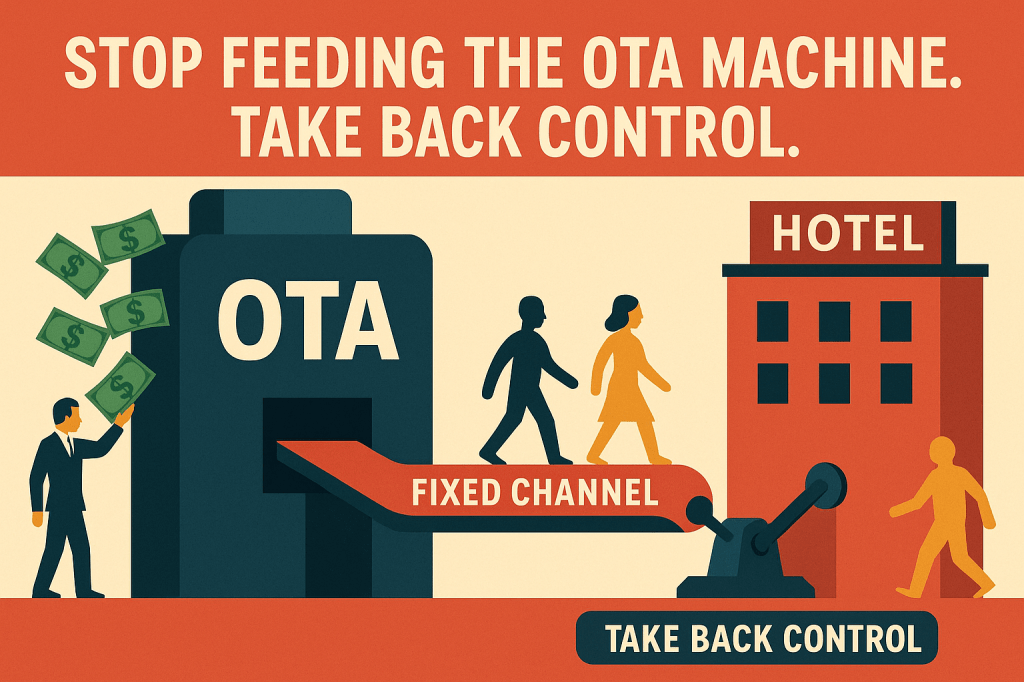
Inspired by “The Budget Paradox: Why Do Hotels Cap Direct Booking Budgets but Give OTAs Unlimited Spend?” by Juanjo Rodríguez, Lighthouse (Oct 14, 2025)
Juanjo Rodríguez’s recent piece on the Budget Paradox highlights a fundamental flaw in how hotels approach their distribution strategy: they cap their most profitable channel — direct bookings — while giving OTAs a limitless budget. As Rodríguez points out, this mismatch constrains growth, rewards inefficiency, and prevents hotels from fully capturing the value of their own guests.
But there’s another layer to this paradox — one that goes beyond budgets and into how we structure direct booking channels themselves.
This is where models like DNA Hotels offer a radically different solution. Instead of paying a hefty, variable commission on every reservation or fighting to squeeze ROI out of a capped marketing budget, DNA Hotels uses a transparent, fixed annual fee (based on the property’s size and average daily rate). That structure alone addresses the cost imbalance Rodríguez identifies — but the real power of this model lies in what it targets.
1. A Cheaper Path to Direct Bookings — Without the “Blank Check” Problem
Rodríguez makes a compelling case for why hotels should rethink fixed direct booking budgets. They artificially limit growth, while OTA commissions — which can easily reach 15–20% per booking — remain uncapped.
The DNA Hotels model solves this imbalance at its root. With a predictable, flat annual cost, hotels aren’t penalized for growth. Every additional direct booking becomes incrementally cheaper — because the cost doesn’t scale with volume.
This reverses the OTA logic: instead of paying more as you succeed, you pay the same — and your profit margin improves with each booking. It’s a far more sustainable way to scale your direct channel.
2. Beyond Price and Location: Targeting the Right Guests
Traditional OTA distribution is a volume game. Listings are driven by price, location, and ranking algorithms — a system optimized for generic visibility rather than strategic guest acquisition.
DNA Hotels flips that approach. Its platform is designed to connect hotels with a specific, high-value audience:
- Design-savvy travellers,
- Guests seeking authentic, character-rich stays,
- People who actively avoid cookie-cutter options and are willing to pay more for originality.
This is more than a marketing nuance — it’s a fundamental strategic shift. Instead of competing on price in an overcrowded marketplace, hotels using DNA Hotels are showcased to travellers already predisposed to book directly and already aligned with the property’s value proposition.
That means fewer “price-sensitive bargain hunters” and more loyal, experience-driven guests — the kind who stay longer, spend more on property, and return.
3. Quality Over Quantity: A Channel That Builds Brand Value
There’s a hidden cost to relying on OTAs that Rodríguez touches on but doesn’t fully explore: brand dilution. When every property is presented in the same templated format, hotels become interchangeable.
By contrast, platforms like DNA Hotels don’t just generate bookings — they curate a context. The focus on design, authenticity, and storytelling elevates a hotel’s brand rather than flattening it. This fosters a more meaningful relationship with the guest from the start, often leading to stronger loyalty and direct repeat bookings.
In other words, the channel isn’t just cheaper — it’s strategically better for long-term brand equity.
4. A Better Fit for Performance-Based Thinking
Rodríguez argues convincingly that hotels should adopt uncapped, performance-based investment models — where marketing spend scales with revenue and doesn’t artificially constrain growth.
DNA Hotels is fully aligned with that vision. By decoupling distribution costs from reservation volume, hotels can invest in growth without fear of budget overruns. Every marginal booking improves profitability, and because the model is inherently scalable, there’s no tension between growth and cost control.
A Smarter Distribution Future
Juanjo Rodríguez’s “Budget Paradox” is a wake-up call for an industry stuck in outdated patterns. Direct bookings should be the priority channel — but to truly unlock their potential, we need to rethink not just budgets, but the entire model behind how we attract and convert direct guests.
DNA Hotels represents one version of that future:
- A channel that is cheaper and predictable.
- One that targets the right travellers, not just the biggest audience.
- And one that builds long-term value instead of eroding it through endless price competition.
In short, it’s not just about spending more on direct bookings — it’s about spending smarter. And that means shifting from the blank-check world of OTAs to a fixed, focused, and brand-aligned distribution model that works with your business, not against it.
 DOUBLEDOWN Hotels
Leave a comment